
Nashville to Memphis is 210 miles west across Tennessee — approximately 3 hours by car via I-40. The drive connects Music City (Nashville) to the Bluff City (Memphis) across the full width of The Volunteer State, passing through farmland, small Tennessee towns, and 2 centuries of American music history along the way.
I’ve driven the Nashville to Memphis route more times than I can count — for weekend trips, for barbecue, for Graceland, and for no reason other than wanting to see the Mississippi River. This guide covers every detail: drive time, distance, the best route, every worthwhile stop between Nashville and Memphis, and all the travel options beyond driving.
Nashville to Memphis Distance and Drive Time
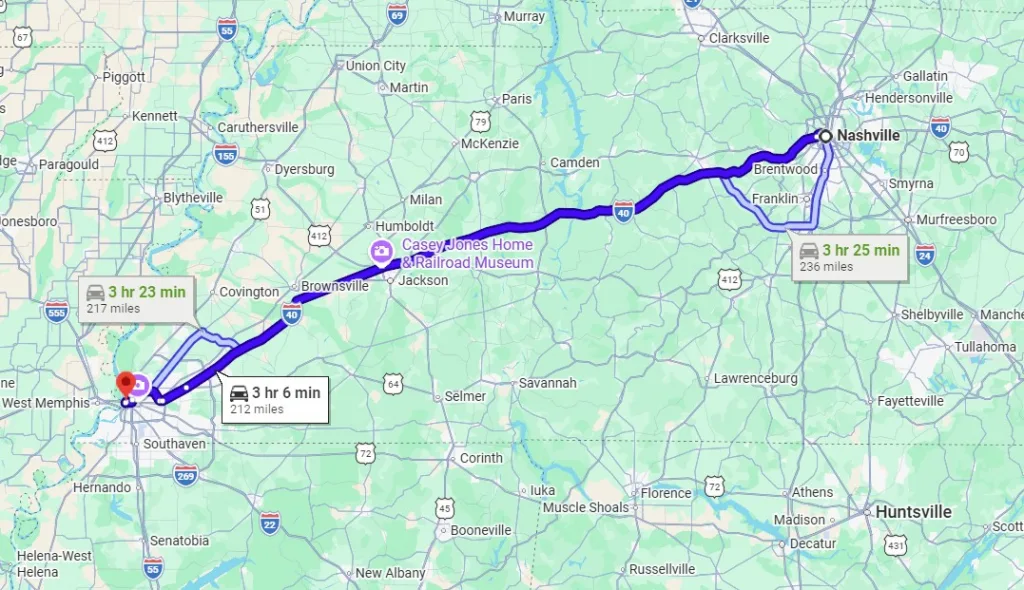
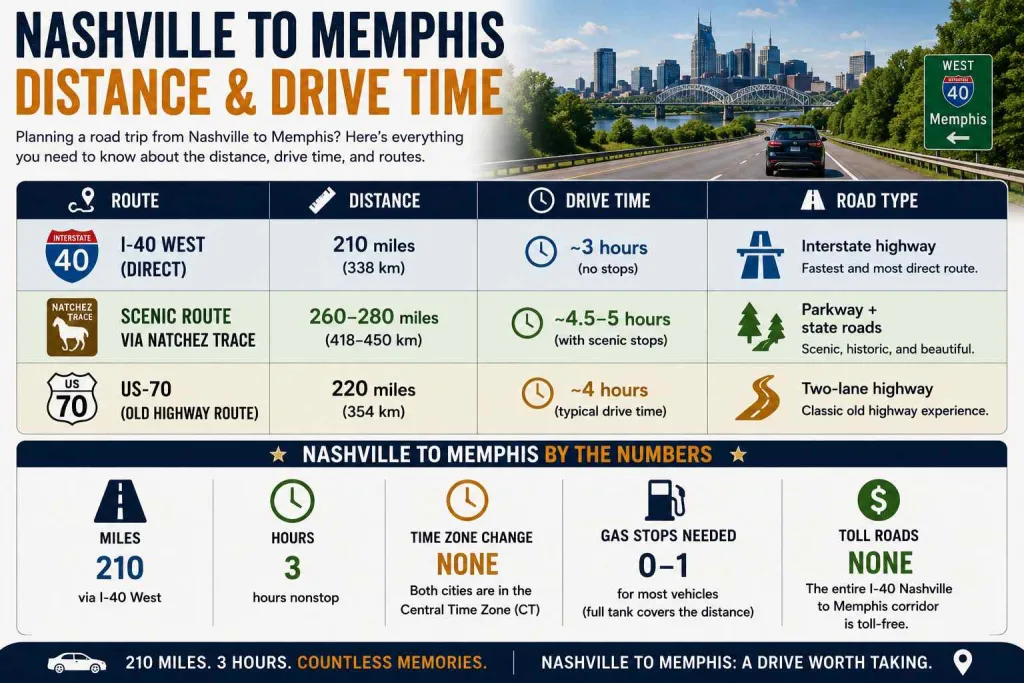
Nashville to Memphis driving distance is 210 miles (338 km) via I-40 West. Nashville to Memphis drive time is approximately 3 hours under normal traffic conditions with no stops.
| Route | Distance | Drive Time | Road Type |
|---|---|---|---|
| I-40 West (direct) | 210 miles (338 km) | ~3 hours | Interstate highway |
| Scenic route via Natchez Trace | 260–280 miles | ~4.5–5 hours | Parkway + state roads |
| US-70 (old highway route) | 220 miles | ~4 hours | Two-lane highway |
Nashville to Memphis by the numbers:
- Miles: 210 via I-40
- Hours: 3 hours nonstop
- Time zone change: None — both cities sit in the Central Time Zone (CT)
- Gas stops needed: 0–1 for most vehicles (full tank covers the distance)
- Toll roads: None — the entire I-40 Nashville to Memphis corridor is toll-free
Best Route: Nashville to Memphis via I-40
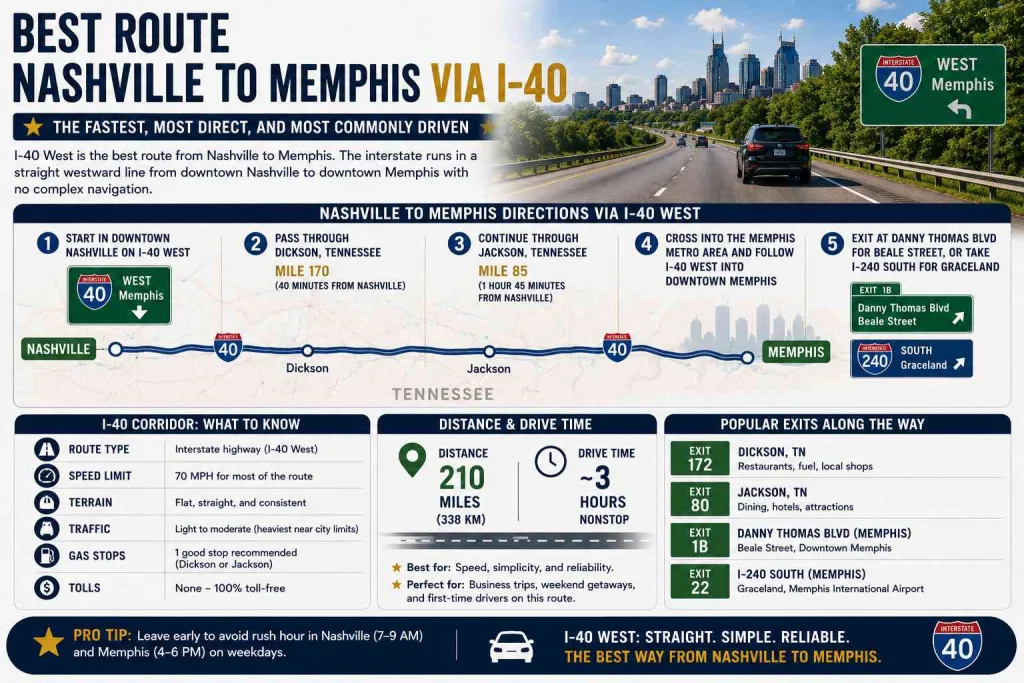
I-40 West is the best route from Nashville to Memphis — the fastest, most direct, and most commonly driven. The interstate runs in a straight westward line from downtown Nashville to downtown Memphis with no complex navigation.
Nashville to Memphis directions via I-40:
- Start in downtown Nashville on I-40 West
- Pass through Dickson, Tennessee at mile 170 (40 minutes from Nashville)
- Continue through Jackson, Tennessee at mile 85 (1 hour 45 minutes from Nashville)
- Cross into the Memphis metro area and follow I-40 West into downtown Memphis
- Exit at Danny Thomas Blvd for Beale Street, or take I-240 South for Graceland
The I-40 corridor between Nashville and Memphis is flat, straight, and consistent. Speed limits hold at 70 mph for most of the drive. Traffic slows at 2 points: the Nashville metro merge (first 15 miles westbound) and the Memphis metro approach (final 10 miles). Both add 5–15 minutes during peak weekday commute hours (7:00–9:00 AM and 4:00–6:30 PM).
Nashville to Memphis Road Trip: 8 Stops Worth Making
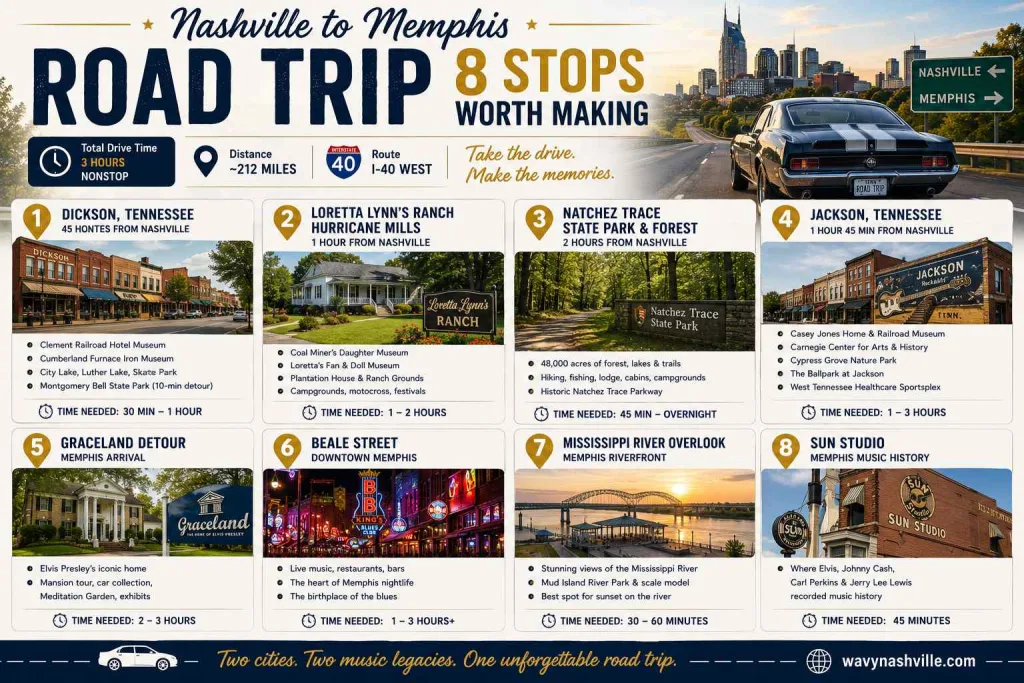
The 3-hour Nashville to Memphis drive is easy nonstop, but the route passes through towns and landmarks that reward a slower pace. These 8 stops sit directly on or within a short detour from I-40, ordered west from Nashville toward Memphis.
Stop 1: Dickson, Tennessee — 45 Minutes From Nashville
Dickson, Tennessee sits in Dickson County about 45 minutes west of Nashville on I-40. Historic Downtown Dickson has a walkable main street with local shops, restaurants, and 2 genuinely interesting heritage sites.
Clement Railroad Hotel Museum — housed in the original Halbrook Hotel — tells the story of Governor Frank G. Clement and Dickson’s railroad history. The museum is small, free, and takes about 30 minutes.
Cumberland Furnace Iron Museum in Dickson County covers the region’s 19th-century iron industry. It’s a niche stop, but the building and grounds are worth 20 minutes, if you’re interested in Tennessee’s industrial past.
City Lake and Luther Lake both sit within Dickson city limits and offer quick picnic spots with water access. Dickson Skate Park and Splash Pad handles a 15-minute kid break on a hot summer drive.
Montgomery Bell State Park is a 10-minute detour south of I-40 from Dickson — trails, a lake, and a lodge. It’s a full stop if you want to stretch your legs properly before continuing to Memphis.
Time needed: 30 minutes–1 hour
Stop 2: Loretta Lynn’s Ranch, Hurricane Mills — 1 Hour From Nashville
Loretta Lynn’s Ranch sits at Hurricane Mills, Tennessee — about 1 hour west of Nashville on I-40 (Exit 143). The property is the former home of country music legend Loretta Lynn and includes the Coal Miner’s Daughter Museum, Loretta’s Fan and Doll Museum, and the plantation house listed on the National Register of Historic Places.
The ranch sits along Hurricane Creek in a valley that looks exactly like a country song sounds. I stopped here on a whim during my second Nashville to Memphis drive and ended up spending 2 hours walking the grounds. The museum collection is personal — Loretta Lynn’s actual dresses, awards, and family photos — and it carries a warmth that corporate music museums don’t replicate.
Loretta Lynn’s Ranch also operates campgrounds, a motocross track (Amateur Motocross events run regularly from March through October), and seasonal festivals. June hosts some of the largest events on the ranch calendar.
Time needed: 1–2 hours
Stop 3: Natchez Trace State Park and Forest — 2 Hours From Nashville
Natchez Trace State Park and Forest sits about 2 hours from Nashville near Wildersville, Tennessee — a 15-minute detour south from I-40 (Exit 116). The park covers 48,000 acres of forest, lakes, and trails named after the historic Natchez Trace pathway that once connected Nashville to Natchez, Mississippi.
This is the biggest natural area along the Nashville to Memphis route. The park has hiking trails, fishing lakes, a lodge, cabins, and campgrounds. A 45-minute stop for a quick hike works well to break the drive. An overnight stay turns the Nashville to Memphis road trip into a 2-day experience with a wilderness layover.
Time needed: 45 minutes–overnight
Stop 4: Jackson, Tennessee — 1 Hour 45 Minutes From Nashville
Jackson, Tennessee is the largest city between Nashville and Memphis and sits at the approximate halfway point on the I-40 corridor. Jackson is known as the birthplace of Rockabilly music — the genre that Carl Perkins pioneered in the 1950s and that directly influenced the rock and roll that came out of Memphis.
Jackson also produced Tina Turner, one of the most recognized performers in American music history. The Ned R. McWherter West Tennessee Cultural Arts Center (locally called The Ned) and the Carl Perkins Civic Center anchor the cultural scene in Downtown Jackson.
5 stops in Jackson, Tennessee worth your time:
- Casey Jones Home and Railroad Museum — the preserved home of legendary railroad engineer Casey Jones; the museum sits in Casey Jones Village, which includes shops and restaurants. This is Jackson’s most visited attraction.
- Carnegie Center for Arts and History — originally the Jackson Free Library, now a regional arts and local history museum
- Cypress Grove Nature Park — a 165-acre wetland nature park with boardwalk trails through bald cypress forest; excellent for a 30-minute walk between driving segments
- The Ballpark at Jackson — a minor league baseball stadium; check the schedule for game-day timing on your Nashville to Memphis drive
- West Tennessee Healthcare Sportsplex — a large recreation facility with family-friendly activities
Where to eat in Jackson: Jackson sits at the crossroads of Nashville hot chicken influence and Memphis barbecue culture — you’ll find both here. Grab lunch in Downtown Jackson before the final 80-mile push to Memphis.
Where to stay in Jackson: SpringHill Suites By Marriott Jackson is the most reliable mid-range hotel option for overnight stays. Union University campus sits nearby for visitors with college-related stops.
Time needed: 1–3 hours
Stop 5: Graceland Detour — Memphis Arrival
Graceland — the home of Elvis Presley — sits at 3764 Elvis Presley Blvd in Memphis, Tennessee. Graceland is the second most-visited private home in the United States (after the White House) and the single most common reason Nashville visitors extend their trip to include Memphis.
Arriving in Memphis via I-40, take I-240 South to the Elvis Presley Blvd exit for direct access to Graceland. The estate includes the mansion tour, Elvis’s car collection, the Meditation Garden, and multiple exhibit halls. Plan 2–3 hours for the full Graceland experience.
Time needed: 2–3 hours
Stop 6: Beale Street — Downtown Memphis
Beale Street in downtown Memphis is the Memphis equivalent of Broadway in Nashville — a concentrated strip of live music venues, bars, and restaurants that anchors the city’s entertainment district. Beale Street runs along the blues music tradition that Memphis built its identity on, and the live music playing out of every door on a Friday night is the reason Memphis earned the title of the birthplace of the blues.
The honky-tonk to soul journey from Nashville’s Broadway to Memphis’s Beale Street is the core experience of the Nashville to Memphis road trip — 2 cities, 2 music traditions, 1 straight interstate connecting them.
Stop 7: Mississippi River Overlook — Memphis Riverfront
The Mississippi River banks in Memphis deliver one of the most striking views along any Tennessee road trip. The Memphis riverfront runs along the western edge of downtown, and standing on the bluff overlooking the Mississippi is a moment that makes the 3-hour drive feel worth it on its own.
Mud Island River Park sits on the riverfront and offers walking access to a scale model of the lower Mississippi River. The view from the bluff at sunset is something I recommend to every Nashville visitor who extends to Memphis.
Stop 8: Sun Studio — Memphis Music History
Sun Studio in Memphis is where Elvis Presley, Carl Perkins, Johnny Cash, and Jerry Lee Lewis recorded some of the most significant music of the 20th century. The grand ole opry to sun studio journey — Nashville’s Ryman Auditorium to Memphis’s Sun Studio — traces the path of American popular music from country to rock and roll to blues.
Sun Studio tours run every 30 minutes and take about 45 minutes. The studio still operates as a recording facility, and the tour walks you through the exact room where these recordings happened.
Time needed: 45 minutes
Nashville to Memphis Scenic Drive: The Natchez Trace Route
The Nashville to Memphis scenic route follows the Natchez Trace Parkway for the first portion of the drive, then connects to state roads and I-40 West for the Memphis approach. The scenic drive adds 50–70 miles and 1.5–2 hours to the total trip, but replaces interstate highway with a 2-lane national parkway that passes through forested ridgelines, historic sites, and rural Tennessee countryside.
The Natchez Trace Parkway runs southwest from Nashville toward Tupelo, Mississippi. To reach Memphis via the scenic route, follow the Trace south for 100–130 miles, then cut west on TN-20 or I-40 to connect to the Memphis metro.
The Nashville to Memphis scenic drive works best as a 1-day road trip with stops or a 2-day trip with an overnight at Natchez Trace State Park. The Trace has no commercial development along the parkway — no gas stations, no fast food, no billboards — which makes it one of the most visually clean drives in the eastern United States. Pack snacks and fill your tank before entering the Parkway.
Nashville to Memphis Flights
Nashville to Memphis flight time is approximately 1 hour and 10 minutes nonstop. Flights operate daily from Nashville International Airport (BNA) to Memphis International Airport (MEM).
| Detail | Info |
|---|---|
| Flight time | ~1 hour 10 minutes |
| Airlines | American, Delta (seasonal schedules vary) |
| One-way fare range | $80–250 depending on booking window |
| Airports | BNA (Nashville) → MEM (Memphis) |
Nashville to Memphis flights make sense for business travelers and time-sensitive trips. For road trips, leisure travel, and anyone wanting to explore stops between Nashville and Memphis, driving the I-40 corridor is the better option — the 3-hour drive costs less than most one-way flights and gives you access to every stop on this list.
Nashville to Memphis by Bus
Greyhound operates bus service from Nashville to Memphis with 2–4 daily departures. Nashville to Memphis bus travel time ranges from 3.5 to 5 hours depending on the number of intermediate stops.
| Detail | Info |
|---|---|
| Operator | Greyhound |
| Travel time | 3.5–5 hours |
| One-way fare range | $20–55 |
| Pickup | Nashville Greyhound Station |
| Drop-off | Memphis Greyhound Station |
The bus is the cheapest Nashville to Memphis travel option for solo travelers without a vehicle. The trade-off is limited departure times, longer travel duration, and no ability to stop along the route.
Nashville to Memphis by Train
There is no direct Amtrak train service from Nashville to Memphis. Nashville does not currently have Amtrak passenger rail service. The closest Amtrak station to Nashville is in Memphis itself (Memphis Central Station) or in other connecting cities.
Nashville to Memphis train travel requires connecting through other cities and adds significant time compared to driving or flying. As of 2026, driving, bus, or flight remain the 3 practical Nashville to Memphis transport options.
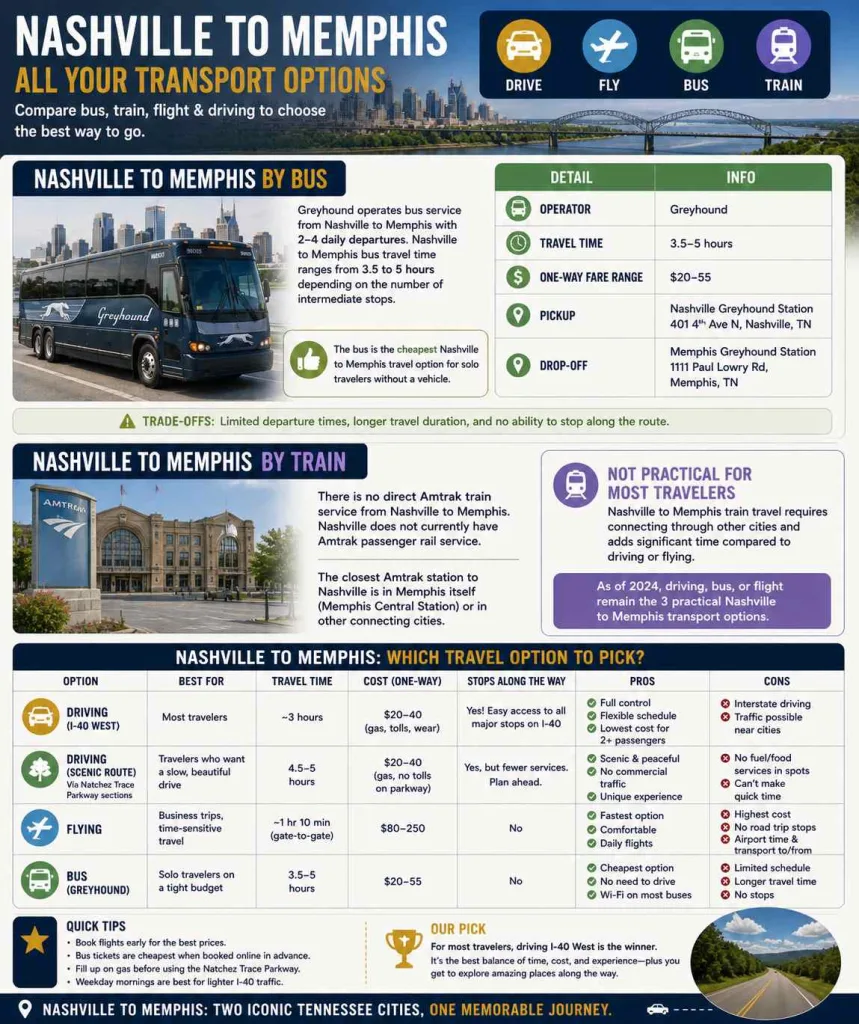
Nashville to Memphis: Which Travel Option to Pick
Pick based on time, budget, and what you want to see:
Driving (I-40 West): Best for most travelers. 3 hours, full control over stops, lowest cost per person for 2+ passengers. The Nashville to Memphis road trip with stops is a top-10 Tennessee travel experience.
Driving (scenic route): Best for travelers who want a slow, beautiful drive. 4.5–5 hours with Natchez Trace Parkway sections. No commercial interruption. Pack food and fuel.
Flying: Best for business trips and time-sensitive travel. 1 hour 10 minutes gate-to-gate. Higher cost ($80–250 one-way). No road trip stops.
Bus (Greyhound): Best for solo budget travelers. $20–55 one-way. 3.5–5 hours. No stop flexibility.
The Southern Cultural Corridor: Why This Drive Matters
The Nashville to Memphis drive crosses 210 miles of Tennessee that produced country music, rockabilly, blues, soul, and rock and roll. The country music heritage drive from Ryman Auditorium in Nashville to Sun Studio and Beale Street in Memphis traces an unbroken line of American musical innovation.
Nashville built country music. Memphis built blues and rock and roll. The I-40 corridor that connects them — this music city delta run through The Volunteer State — is one of the most musically significant drives in the United States.
Carl Perkins played in Jackson. Tina Turner grew up near Brownsville. Elvis recorded in Memphis and performed at the Grand Ole Opry in Nashville. Loretta Lynn’s Ranch sits halfway between the two cities on Hurricane Creek. The guitar town crossroads along this route shaped American popular music, and driving it puts you inside that history in a way that reading about it doesn’t replicate.
A Final Word From Someone Who Drives This Route Regularly
The Nashville to Memphis drive is 3 hours of flat, easy highway through the heart of Tennessee. I’ve done it in a single push and I’ve done it over 2 days with stops at Loretta Lynn’s Ranch, Jackson, and Natchez Trace. Both versions work. The slow version is better.
Memphis earns the drive from Nashville every time. The barbecue alone is worth 3 hours. Graceland is worth 3 hours. Standing on the bluff above the Mississippi River watching barges pass below is worth 3 hours. And the music — from Nashville’s honky-tonks to Memphis’s Beale Street juke joints — tells a story that only makes sense when you’ve driven the road between them.
Pack the car. Fill the tank. Take I-40 West. You’ll be eating Memphis barbecue before the playlist runs out.