
Printed ribbon is the cheapest branded surface most small businesses will ever own, and the one they think about last. On a merch table, a gift shop counter or a hotel turndown tray, it is the element that survives the transaction: the bag is folded away, the tissue paper is binned, the ribbon ends up tied around something else.
Understanding what the material and the printing method actually do avoids the two classic mistakes, ink that cracks and a weave that will not hold a knot.
Key points
- Nashville’s music and entertainment industry supports 80,757 jobs and had an 8.6 billion dollar impact on the metro area in 2020.
- Dye sublimation only bonds to polyester, and it works at roughly 200 degrees Celsius.
- Satin is defined by its weave, not by its fibre: satin polyester and satin silk behave very differently under print.
- Grosgrain holds a knot better than satin and takes a different kind of print.
- The width of the ribbon decides how much text is legible, not the size of the logo file.
Why finishing matters more in a maker economy
Nashville’s creative economy is not a side activity. A study by Belmont University with the Nashville Area Chamber of Commerce put the economic impact of the music and entertainment industry in the Nashville area at 8.6 billion dollars in 2020, up 43 % on the 6.1 billion recorded in 2013, supporting 80,757 jobs and 6.3 billion dollars in employee compensation.
Around that core sits an entire layer of small independent businesses, labels, studios, boutiques, coffee roasters, hat makers, venues with a merch table. These operations rarely have a packaging budget in the industrial sense. What they have is a run of a few hundred units, a logo, and one or two chances to make the object feel finished. That is exactly the situation printed ribbon is good at.
Satin, grosgrain, cotton: what the weave changes
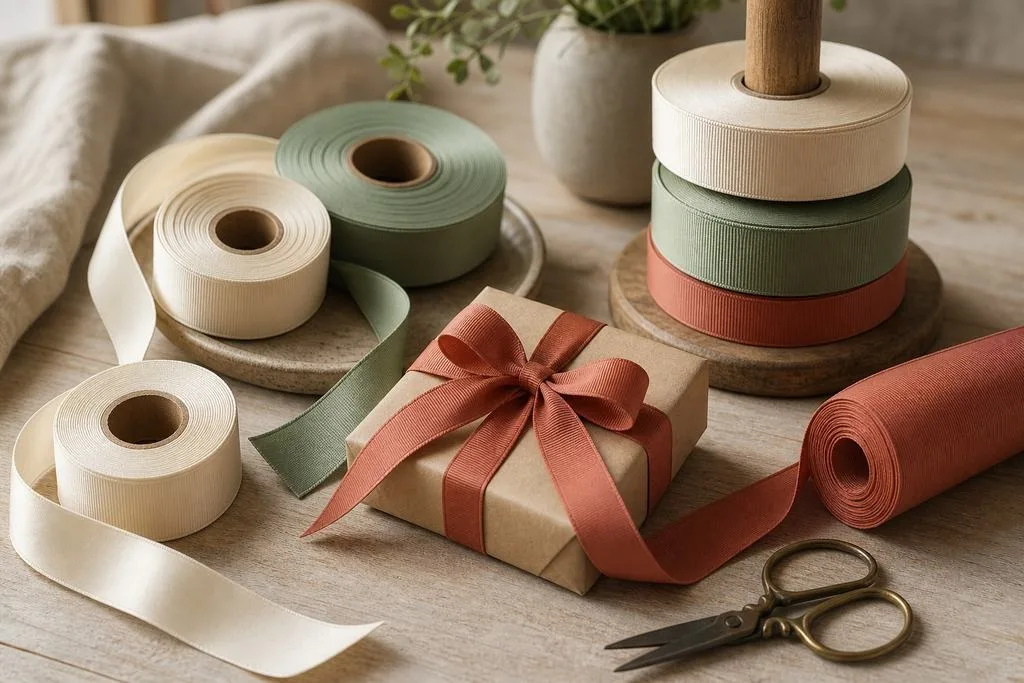
The word satin describes a weave, not a fibre. In a satin weave, the warp threads float over several weft threads before passing under one, which is what produces the smooth, reflective face and the duller back. Grosgrain uses a ribbed weave, so the surface is matte, textured and noticeably stiffer.
That structural difference decides three practical things: how the ribbon takes ink, how it holds a knot, and how it ages. A satin face gives the crispest print because the surface is flat and continuous. A grosgrain rib scatters fine detail slightly but grips far better, which is why it is the default on anything that has to stay tied while it travels.
French converters keep the distinction explicit in their product naming: a ruban satin imprimé sur mesure designates a satin-weave ribbon printed to a specific brand’s artwork, as opposed to a plain stock ribbon or a woven jacquard where the pattern is created by the weave itself rather than applied to it. The three are often confused in briefs, and they have different lead times and different minimum practical widths.
| Ribbon | Surface | Print behaviour | Best use |
| Satin polyester | Smooth, glossy face | Sharp detail, takes sublimation | Gift wrapping, retail packaging |
| Grosgrain polyester | Ribbed, matte | Slight loss of fine detail | Bags, anything that must stay tied |
| Cotton or linen tape | Matte, absorbent | Softer edges, ink sinks in | Natural and craft positioning |
| Woven jacquard | Pattern is in the weave | No ink at all | Labels, long-life branding |
Printing methods, and why polyester keeps winning
Dye sublimation is the method behind most full-colour printed ribbon, and it has one hard constraint: it bonds to polyester and to almost nothing else. The colorant is a solid that turns to gas under heat, typically around 200 degrees Celsius, penetrates the polymer, and locks in place as the material cools. The result sits inside the fibre rather than on top of it, which is why a sublimated ribbon does not crack when it is folded or tied.
The trade-off is equally hard. On cotton, linen or any natural fibre, sublimation has nothing to bond to, so those materials are printed with pigment or screen methods that deposit ink on the surface. That ink is visible, slightly raised, and vulnerable to abrasion at the fold. Neither approach is better in the abstract; they belong to different material choices, and the choice has to be made before the artwork is designed.
Designing artwork that survives the width
The single most common briefing error is treating a ribbon like a small banner. It is not: it is an extremely long, extremely narrow surface, usually seen in fragments, often at an angle, and frequently upside down.
Repeat rather than centre. Nobody sees the whole length. A repeating motif with a defined pitch guarantees that any cut section carries the brand, whereas a single centred logo is present on some pieces and absent from others.
Drop the taglines. On a narrow ribbon, a second line of text is unreadable in real conditions. Wordmark, or symbol, or one of the two, never a hierarchy of three elements.
Test the knot. Print a proof, tie it the way it will actually be tied, and look at what remains visible. The knot itself consumes a surprising amount of surface, and it always falls in the wrong place first time.
Check the reverse. On satin, the back face is duller and, depending on the process, may carry no print at all. A bow shows both faces, so a design that relies on colour continuity will look inconsistent once tied.
FAQ
Does printed ribbon fade in sunlight?
Sublimated polyester holds colour well because the dye sits inside the fibre, but shop-window exposure over months will lighten any colour. Deep saturated tones show the shift less than pale pastels.
Can printed ribbon go through a wash?
Sublimated polyester survives a domestic wash; surface-printed cotton usually does not. If the ribbon stays on a garment or a reusable bag, that question has to be settled before choosing the material.
What width should be ordered?
It depends entirely on the artwork and on what the ribbon has to tie. A wordmark alone tolerates a narrow tape; a logo with a symbol needs more height. The reliable method is to print the artwork at scale on paper, cut it to the candidate widths and look at it on the actual product.
Is woven jacquard worth the extra step?
For a label that has to last the life of the product, yes, because there is no ink to wear off. For seasonal packaging, no, because the setup is heavier and the colour range narrower than print.
How should ribbon be stored?
On the roll, in the dark, away from radiators and damp. Loose lengths crease permanently, and a crease across a printed motif is visible on every piece cut from that section.