
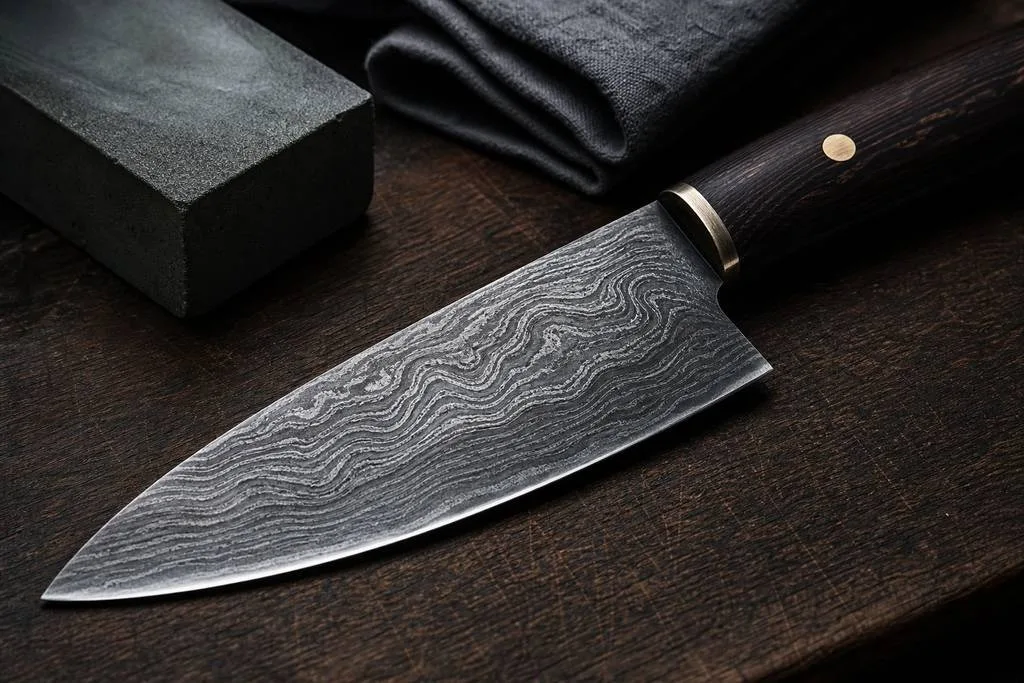
A Damascus knife is not a different kind of steel. It is a construction: two alloys forge-welded together, folded, and then etched so that one of them darkens and the other stays bright. The pattern you see is a map of that process, and it says almost nothing about how well the blade will cut. What decides the cutting is hidden underneath, in the core steel and the heat treatment.
Key points
- Modern Damascus is pattern-welded steel, not the historical crucible steel of the same name.
- The visible pattern comes from an acid etch that affects the two alloys differently.
- On a laminated blade, the edge belongs to the core steel alone; the outer layers are cladding.
- A steel is only stainless from 10.5 % chromium upward, and many Damascus outer layers are deliberately not stainless.
- Nashville visitors spent a record 11.6 billion dollars in 2025, with dining and experiences driving the growth.
Why kitchen tools are a Nashville story now
Music City has become a food city, and the numbers behind that shift are not small. The Nashville Convention and Visitors Corp reported a record 11.6 billion dollars in visitor spending in Davidson County in 2025, up 3.5 % on the previous year, with 17.4 million day and overnight visitors and growth driven by dining, concerts and sporting events. Direct visitor spending generated 1.2 billion dollars in state and local tax revenue.
That volume changes kitchens. Restaurants running two hundred covers a night wear through equipment differently from a neighbourhood room doing sixty, and the knife roll becomes a maintenance question rather than a purchase question. It also explains the visible drift toward makers’ knives on the pass: a blade that can be re-ground and re-handled outlasts several factory replacements.
What Damascus actually means today
Two very different things share the name. Historical Damascus, more accurately crucible or wootz steel, was produced from ingots with a distinctive internal carbide structure, and that production line effectively disappeared centuries ago. Everything sold today under the label is pattern-welded steel: alternating layers of two alloys, forge-welded, drawn out, folded, and manipulated to create ladder, raindrop or twist patterns.
The visual contrast comes at the end. The finished blade is dipped in an acid solution; the alloy with a higher nickel content resists the etch and stays bright, the other one greys or blackens. Change the pair of alloys and you change the contrast, which is why some blades read almost black-and-white and others look like faint watermarks.
French workshops have kept the vocabulary distinct, and a couteau lame damas artisanal refers specifically to a hand-forged pattern-welded blade rather than to a stamped blade with a printed or laser-etched imitation pattern. The distinction matters commercially, because printed patterns exist and are difficult to identify from a photograph. On a genuine forged blade the pattern continues through the edge bevel and is visible on the spine; on a printed one it stops at the surface.
Reading a blade: layers, core, edge
Most quality Damascus knives are laminated. A hard core steel is sandwiched between patterned outer layers, a construction known in Japan as san mai. The core is what meets the cutting board. The cladding adds lateral toughness, corrosion behaviour and appearance, and nothing else.
This is where the chromium threshold matters. A steel is classified as stainless from 10.5 % chromium upward. Many makers deliberately use a non-stainless outer layer because it takes the etch better, which means the visible surface can patinate even when the core is fully stainless. A dark bloom on the flat of the blade after a night with acidic prep is a property of the cladding, not a defect.
| Construction | Where the edge comes from | Practical behaviour |
| Full pattern-welded blade | The welded billet itself | Edge quality varies with the alloys used |
| Laminated core with patterned cladding | The core steel only | Predictable edge, decorative flanks |
| Monosteel with etched surface | The single steel | Pattern is cosmetic, stops at the surface |
| Printed or coated pattern | The base steel | Pattern wears off with sharpening and use |
Care, and what actually ruins a pattern
Three habits destroy more Damascus blades than any amount of cutting.
The dishwasher. Alkaline detergent strips the patina unevenly and attacks natural handle materials. On a laminated blade it produces blotches that no polishing fully removes, because the two alloys react at different rates.
Aggressive polishing. Metal polish and abrasive pads flatten the etch relief. The pattern fades not because the steel changed but because the surface differential has been rubbed away. Restoring it requires re-etching, which is a workshop operation.
Pull-through sharpeners. They remove far more metal than a stone and do it unevenly. On a laminated blade, aggressive removal eventually eats into the geometry that keeps the core centred, and the blade starts steering in the cut.
The maintenance that works is unremarkable: wash by hand in warm water, dry immediately, keep the blade off other metal in the drawer, and use a stone or a professional service twice a year rather than a device on the counter.
FAQ
Does a Damascus blade cut better than a plain one?
Not because it is Damascus. Two knives with the same core steel, the same geometry and the same heat treatment cut the same, whether or not the flanks are patterned. The pattern is a construction and finishing choice.
How can I tell a forged pattern from a printed one?
Look at the spine and the edge bevel. On a forged blade the layers are visible there, because they run through the whole cross-section. A printed pattern lives on the flat surfaces only and disappears where the bevel has been ground.
Will the pattern fade over time?
Slowly, with use and cleaning, because the etch relief is shallow. It can be brought back by re-etching, which most makers offer as a service. Polishing it yourself accelerates the fading rather than fixing it.
Are Damascus knives harder to sharpen?
No, if the blade is laminated: you are sharpening the core steel, exactly as on a monosteel knife. A fully pattern-welded blade with mixed alloys can feel less consistent on a stone, which is one reason laminated construction has become the norm for kitchen work.
Is a patterned blade a good buy for a working kitchen?
It depends on who maintains it. In a service kitchen where knives are shared, thrown in a bin and sharpened by whoever is closest, a plain blade survives better. Where each cook owns and maintains their own roll, a forged blade is a reasonable long-term tool.