

A routine drive toward Memphis can turn into a crash scene in seconds. If it happens to you, the record you build over the next few days may matter more than you expect. By evening, your car could be sitting in an unfamiliar tow yard outside Jackson, with nothing left at the scene but your notes.
Safety comes first, then medical care, then documentation. Tennessee attorneys prove fault by comparing driver accounts with physical evidence, crash reports, witness information, medical records, and vehicle data tied to the collision. No single photograph settles responsibility.
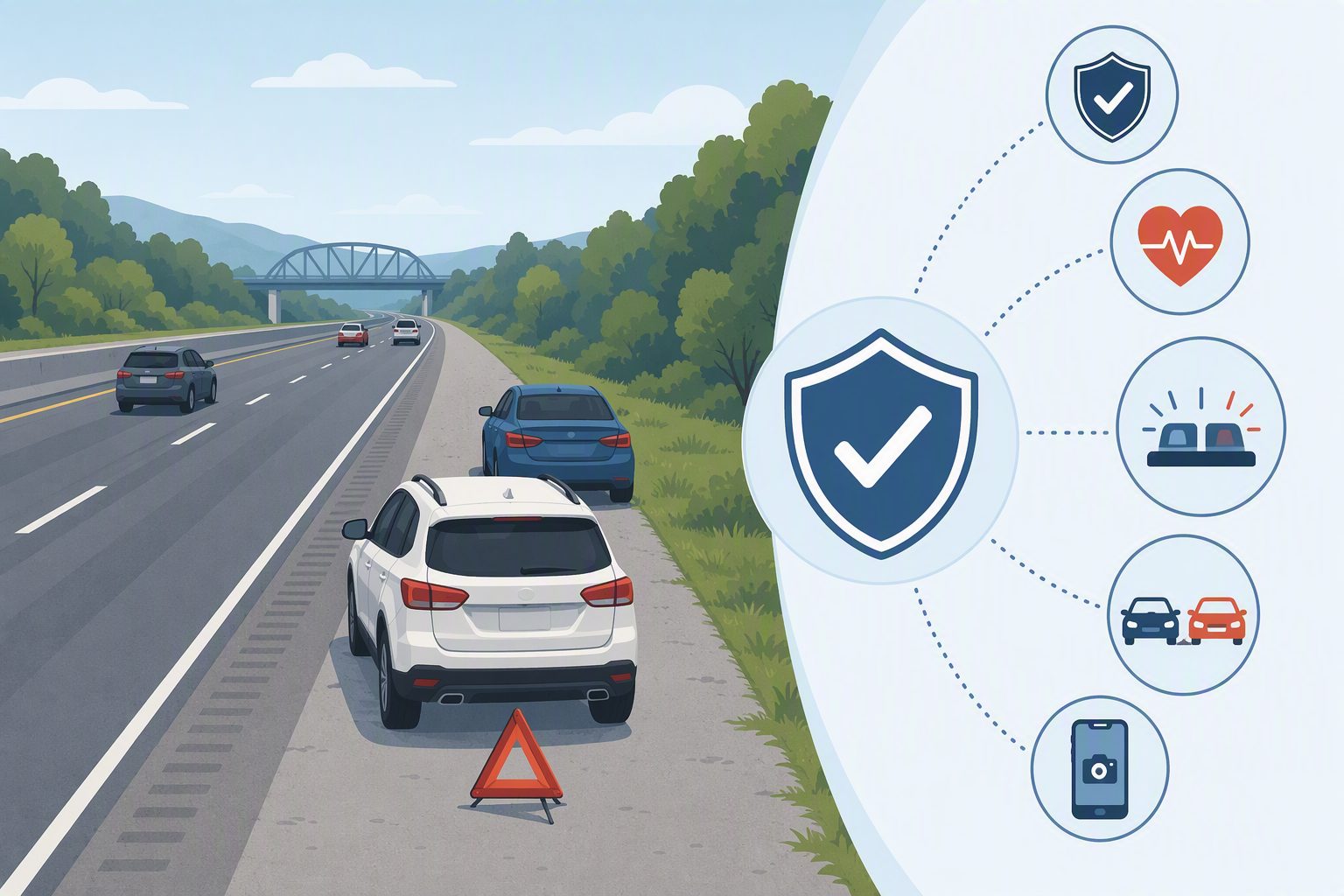
What Should You Do Immediately After a Tennessee Road-Trip Crash?
The first hour follows a clear order, and what you do matters for how attorneys prove fault in Tennessee. If responders ask you to do something differently, follow their instructions.
Put Safety and Medical Needs Before Photographs
- Get away from traffic, fire, or roadway danger when it is safe to do so.
- Call 911 and follow the dispatcher’s instructions.
- Request medical help for anyone who might be injured.
- Follow police and emergency-responder directions.
- Exchange required information once you’ve addressed immediate hazards.
- Begin documenting only if injuries and conditions allow it.
- Record where the vehicle is being towed before you leave the scene.
Never stand in moving traffic. Never delay treatment for a photograph. Whether you should move a vehicle depends on road conditions, injuries, police directions, and applicable requirements.
Create a Time-Stamped Record Before Details Blur
Open the notes app on your phone, or start a voice memo if that is easier. Begin with the approximate collision time and road name, then add the nearest exit or intersection, your direction of travel, and the weather. Note when emergency responders arrived and where the vehicle is being taken.
Keep observations separate from guesses. “The traffic light facing me was green” is an observation. “The other driver was distracted” is an inference unless a witness or record supports it. A timeline that distinguishes between the two is far more useful later.
Which Photos Help Show What Happened?
The most useful crash-scene photos show the vehicles in context, the road layout, visible damage, traffic controls, surface conditions, and temporary evidence that may disappear after cleanup. Wide photographs beat close-ups of damage alone.
Photograph the Whole Scene Before Focusing on Damage
If conditions allow you to photograph safely, capture:
- Wide views showing every vehicle’s location and direction
- The approach to the crash from each safe viewpoint
- Lane markings, intersections, traffic signals, and road signs
- Vehicle damage from several angles
- Debris, tire marks, fluid trails, and damaged roadside objects
- Weather, lighting, standing water, construction, or blocked sightlines
- License plates and visible commercial markings
- Personal property or luggage damaged in the collision
- The tow truck and the company name displayed on it
Do not crowd injured people with a camera or post crash images on social media. If responders need the area cleared, leave immediately.
Preserve Original Files and Their Metadata
Keep the original image files, not screenshots or edited copies. Leave embedded date and location data intact, because that information may matter later. Back the files up to cloud storage, or send the originals to someone you trust if your phone might be lost or damaged.
Want to annotate an image? Duplicate it first and mark the copy. Do not crop the only original or alter it in a way that misrepresents the scene.
Note on File Integrity: In legal proceedings, altering, cropping, or destroying original image files or their metadata can trigger allegations of evidence spoliation. In Tennessee courts, spoliation can lead to sanctions or negative jury instructions, making it essential to retain unedited, original files on a backup drive.
Photograph Details That Could Disappear
Construction zones change overnight. Skid marks fade, debris gets swept away, temporary traffic controls come down, and standing water dries. None of this conclusively proves fault on its own, but a photograph can preserve a condition that no longer exists when an insurer, attorney, or reconstruction professional examines the location.
How Tennessee Attorneys Prove Fault When Drivers Disagree
When drivers give conflicting accounts, investigators compare them with available records. The Tennessee Department of Safety and Homeland Security publishes Tennessee crash data, including information about contributing circumstances such as distracted driving. Distraction may not be obvious at the roadside, so comparing evidence is important.
Evidence Must Be Tested Against Tennessee’s Fault Rules
An attorney’s investigation may compare each driver’s account with vehicle positions, damage patterns, scene photographs, the crash report, medical documentation, witness statements, vehicle data, and reconstruction evidence. Tennessee follows a modified comparative fault framework under McIntyre v. Balentine, 833 S.W.2d 52, 57 (Tenn. 1992), known as the “49 percent rule”. A claimant may recover damages only if their share of fault is strictly less than 50 percent (49 percent or lower), with recovery reduced by that percentage. If the claimant is assigned 50 percent or more of the fault, recovery is completely barred.
Under Tennessee’s comparative fault system, a claimant’s negligence is evaluated against the aggregate fault of all responsible entities—including multiple defendants and non-parties assigned fault—rather than measured solely against a single driver.

Photographs, police reports, independent witnesses, medical records, and reconstruction evidence all feed that comparison, and a well-organized crash file gives an attorney more material to work with when accounts conflict. Documentation supports fact-finding; it does not establish fault, guarantee compensation, or replace an investigation.
Who Ultimately Decides Fault?
An insurance adjuster may take an initial position on fault, but that position is not automatically final. The parties may negotiate an allocation and settle. If a lawsuit proceeds to a decision, a judge or jury assigns percentages of fault under Tennessee’s comparative-fault framework. A police report or citation can inform the investigation, but responsibility for a civil claim rests on the complete evidence and applicable law.
Can Witness Details, Receipts, and Symptom Notes Support a Claim?
Yes. Witness details help investigators locate an independent account, receipts document crash-related expenses, and dated symptom notes preserve a timeline for medical review. Each record supports a different part of the investigation, and none proves the entire claim on its own.
Record Witness Information Before People Leave
Witnesses may leave before police finish their work, so collect details early if conditions safely allow it. Ask for the person’s full name, phone number, and email address. Note where the witness was positioned, and record a short account in the witness’s own words. If the person agrees to an audio or video statement, preserve the original file and note when you made it.
Do not coach the witness, supply details, or ask the person to decide who was at fault. A neutral description of what the witness saw carries more weight than a prompted conclusion.
Witness statements usually do not establish fault on their own. Investigators compare the account against scene evidence and other records.
Keep Every Crash-Related Travel Receipt Together
A crash can produce towing charges, storage fees, replacement transportation, additional lodging, rebooking fees, rental extensions, and damaged property. Create one digital folder for these records. Keep the original receipts, add a brief note explaining each cost, and save cancellation confirmations plus relevant communications with hotels, rental agencies, and tour providers.
Whether an expense is reimbursable turns on the available coverage, applicable law, and the facts of the claim. Organized records make each expense easier to evaluate.
Write Down Symptoms That Appear Later
Some symptoms may not show up at the roadside. Dizziness, headaches, and pain can appear hours later. Seek appropriate medical care rather than treating a personal log as a diagnosis.
When you take notes, record when the symptom began, where you were, what activity it affected, and when you requested medical care. Keep each entry factual and skip medical conclusions. A note such as “Headache began the evening we arrived in Memphis; missed the dinner reservation” creates a clearer timeline than a general description written weeks later.
What Changes in Four Common Tennessee Road-Trip Scenarios?
Every crash requires attention to safety and documentation, but road trips can add practical challenges.
A Minor Fender Bender
Limited visible damage does not eliminate the need for a basic record. Take wide scene photographs and close-ups of the damage. Exchange information, request the report or incident number when one exists, and write down relevant conversations while they are fresh.
Do not rely on a verbal promise that someone will pay later. Not every minor collision produces a viable injury claim, but preserving basic information helps you evaluate the incident accurately.
A Serious Collision
When injuries are serious, documentation takes a back seat. Let emergency responders work. If you cannot document the scene, a passenger or trusted companion may preserve information without interfering with treatment or the investigation.
Someone should confirm which hospital is providing treatment and which tow yard is holding the vehicle. Locate the luggage, note the responding agencies, and identify one contact person who can manage hotel and transportation changes.
Proving Fault in a Tennessee Rental-Car Accident
Fault in a Tennessee rental-car crash is investigated with the same underlying collision evidence as any other crash. The driver should also preserve the rental agreement, checkout inspection, damage report, rental-company communications, and records showing who was authorized to drive.
Follow the reporting instructions in the rental agreement and retain confirmation of every notice you send. Preserve photographs taken at pickup, particularly images of pre-existing damage. Keep three issues separate: who caused the collision, who contracted with the rental company, and which insurance or card benefits may apply. Coverage turns on the terms of the relevant contracts and policies.
A Crash That Disrupts a Multi-City Itinerary
Preserve the original itinerary alongside hotel bookings, tickets, and records showing why plans changed. Keep replacement transportation receipts and cancellation notices in the same folder.
If your vehicle is towed, record where the luggage, medications, child seats, and mobility equipment went. Travelers rearranging a multi-city trip after a crash on the Nashville to Houston Travel Guide route can consult that guide for rebooking logistics, though it does not cover crash procedures.
What Evidence Helps Connect the Record to a Legal Claim?
Liability Evidence and Injury Evidence Answer Different Questions
Liability evidence addresses how the collision happened and who contributed to it. Medical records and expense documentation address the resulting injuries and losses. A contemporaneous symptom timeline may help connect the collision chronology with later treatment.
Tennessee negligence law requires a plaintiff to prove five elements: duty, breach, injury or loss, cause-in-fact, and legal (proximate) cause. McCall v. Wilder, 913 S.W.2d 150, 153 (Tenn. 1995) established this core formulation (and Giggers v. Memphis Housing Authority, 277 S.W.3d 359, 364 (Tenn. 2009) later applied it in a premises liability context). Each element requires supporting evidence.
A Clean File Beats a Large Unsorted One
Sort records by date and category. Keep scene evidence in one folder, police and towing materials in another, medical records in a third, travel expenses in a fourth, rental documents in a fifth, and correspondence in a sixth. Good organization does not guarantee a favorable result, but it makes the evidence far easier to review.

Tennessee Fault and Damages Questions Travelers Often Ask
Is Tennessee a Fault-Based State?
Yes. Tennessee uses a fault-based system for civil claims arising from vehicle crashes. Responsibility and recoverable damages may change according to the percentages of fault allocated under McIntyre v. Balentine, 833 S.W.2d 52 (Tenn. 1992).
How Difficult Is It to Establish Liability After a Crash?
It varies with the available evidence and how much the accounts conflict. A case may be harder to establish when vehicles have been moved, no independent witness can be located, photographs lack context, or several drivers may have contributed. Severe vehicle damage alone does not establish how the collision happened.
Can You Recover for Emotional Distress in Tennessee?
Sometimes, if supported by the required evidence. Tennessee recognizes negligent infliction of emotional distress (NIED) within its standard negligence framework under Camper v. Minor, 915 S.W.2d 437, 446 (Tenn. 1996) and Rogers v. Louisville Land Co., 367 S.W.3d 196, 206 (Tenn. 2012). However, for stand-alone NIED claims (where no physical injury occurs), Tennessee law requires the plaintiff to present expert medical or scientific testimony proving a severe or serious emotional injury. Ordinary worry or a disrupted vacation does not qualify.
What Proof Supports an Emotional-Distress Claim?
Relevant evidence may include medical or psychological records, symptom history, treatment records, provider testimony when required, and evidence connecting the condition to the collision. The required proof varies with the claim and the surrounding injuries.
How Much Can Someone Receive for Pain and Suffering in Tennessee?
There is no fixed payment. Recovery depends on the evidence, injury severity, assigned fault percentages, available insurance coverage, and statutory caps. Under Tenn. Code Ann. § 29-39-102, non-economic damages (such as emotional distress) are generally capped at $750,000 per injured plaintiff. That cap increases to $1,000,000 for defined catastrophic injuries, such as severe spinal cord injuries resulting in paraplegia or quadriplegia, double amputations, or third-degree burns covering over 40 percent of the body. The Tennessee Supreme Court confirmed the constitutionality of this cap in McClay v. Airport Management Services, LLC, 596 S.W.3d 686 (Tenn. 2020).

Keep the Record Useful After the Road Reopens
The order stays the same: protect people, obtain appropriate care, preserve what can safely be documented, and keep later records tied to dates and locations.
Weeks after the trip, a clearly labeled folder holding the crash report number, original photographs, medical records, and tow-yard receipt can preserve details that would otherwise be difficult to reconstruct. Focus first on safety and treatment, then let an organized record carry the facts.