
When most people picture Nashville, they think of Broadway, rooftop bars, live music, and long lines outside brunch spots. And I love that version of Nashville and write about it all the time.
But after years of exploring this city for WavyNashville.com, I’ve realized that some of my favorite Nashville moments have nothing to do with honky tonks or hot chicken. They happen on abandoned airport runways in East Nashville, in 2,000-acre forests most locals have never visited, and on trails that lead to places with stories stranger than fiction.
This Nashville Guide is for people who want the greener and calmer side of Nashville. Most of these spots are not showing up on the typical tourist itinerary. Some of these places I discovered through friends, some through online forums where Nashville locals share their secret favorites, and some I stumbled into completely “by accident”.
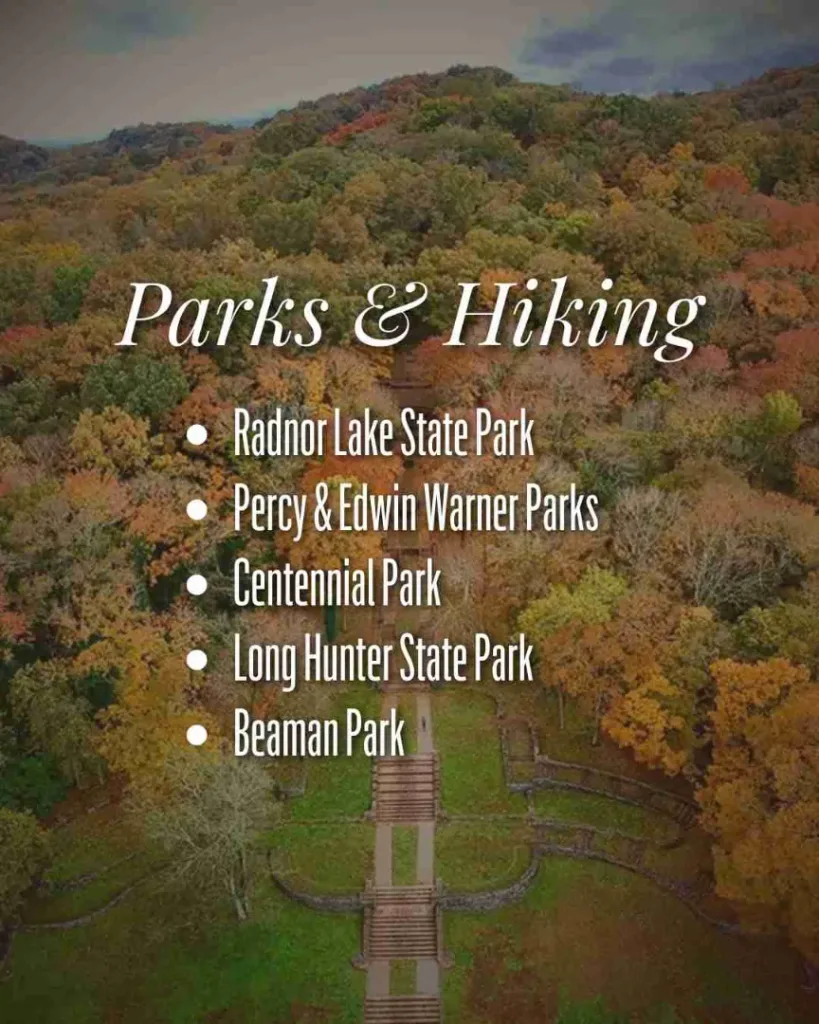
1. Bells Bend Park – Nashville’s Most Overlooked Nature Spot
Bells Bend Park is probably the most underrated park in Nashville, and I’m not exaggerating. This 808-acre preserve sits in a rural bend of the Cumberland River in west Nashville, surrounded by working farms and protected floodplain. It’s Nashville’s fourth-largest park, and yet every time I go, I can count the other visitors on one hand.
The landscape here is completely different from anything else inside city limits. Open meadows, tall wildflower fields, forested knolls, and ponds stocked with fish. The Bells Bend Loop Trail is a five-mile walk through all of it, and the low elevation makes it manageable for families. The outdoor center even offers free mountain bikes and helmets for use on the mountain bike trail, which I didn’t know about until my third visit.
What really got me was the wildlife. A TripAdvisor reviewer described the location perfectly – other than the occasional airplane overhead, you’d never know you were near Nashville. The ranger told them you can sometimes spot bald eagles from the river trail. I haven’t seen one yet, but I’ve seen herons, egrets, and enough deer to make it feel like a nature preserve, not a city park.
The outdoor center is open Tuesday through Friday and Saturday mornings. The park itself is open dawn to dusk, seven days a week. There are also ten campsites with picnic tables and a central fire ring, which makes Bells Bend one of the only places you can camp inside Nashville.
Spring is the best time for wildflowers, and summer evenings are magical if you can handle the heat. Two large ponds are stocked with fish, making it a great spot for families with kids who want to try casting a line for the first time.
2. Radnor Lake – The Quietest Place Inside City Limits
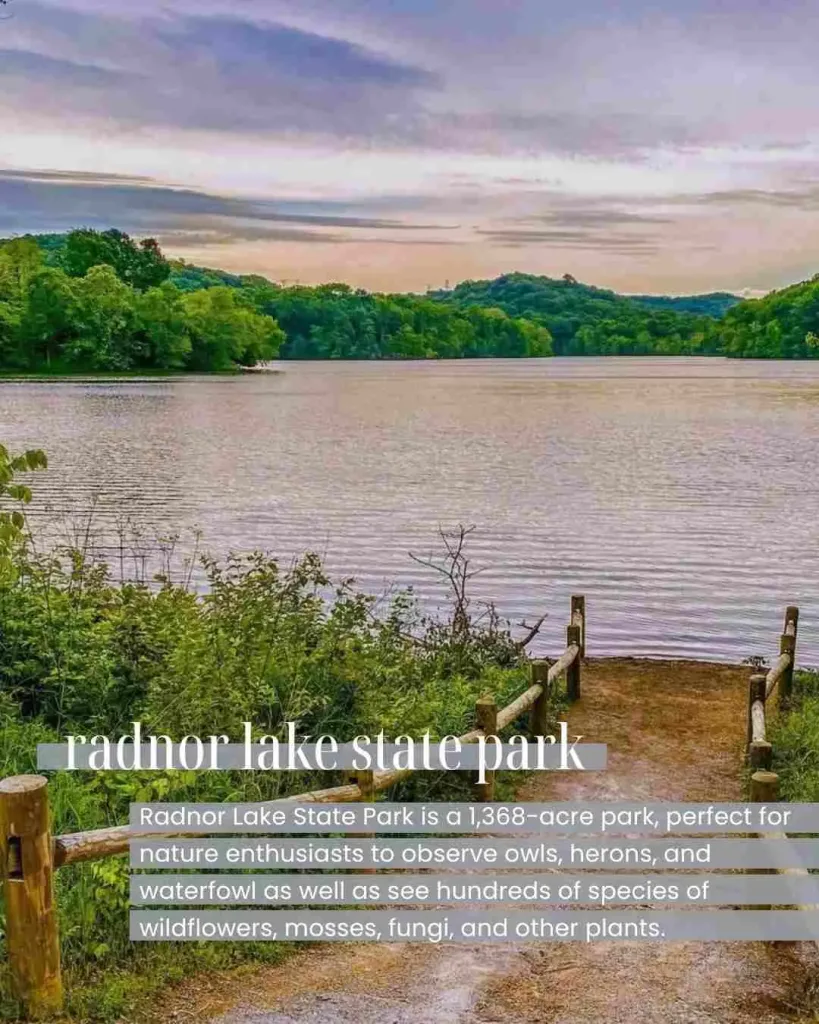
Radnor Lake State Park is located about fifteen minutes south of downtown, and I hike here regularly because the wildlife viewing is genuinely exceptional. The park operates under stricter rules than most Nashville parks, which means no bikes, no pets, no swimming, and no fishing. To me, that’s exactly what makes it feel like a completely different world.
Since 2022, a pair of bald eagles has been nesting at Radnor Lake, and in spring 2025, three eaglets were confirmed. That’s a rare and exciting sight that reflects many years of careful stewardship. The Friends of Radnor Lake announced the news and it still amazes me that bald eagles are raising a family eight miles from downtown.
The South Cove Trail and Lake Trail have easy and mostly flat loops. The Ganier Ridge Trail has a bit more elevation and gives you an overlook where you can see the downtown skyline through bare winter trees. The parking spots are filling up fast on the weekends. The Otter Creek Road entrance is less crowded than the main lot off Granny White Pike. If the lot is full, the park closes the gate. So it’s best to plan getting there before 9 AM on Saturdays or to go on a weekday.
In my personal opinion this is the single best green escape in Nashville for people who are looking for a genuinely quiet and still place in nature. If you only have time for one nature stop on a Nashville visit, this is the one I would choose.
3. Beaman Park – A Great Place For Hiking Enthusiasts
Beaman Park is the spot I recommend to anyone who says they want real hiking without having to really leave Nashville. It’s located in northwest Nashville, 2,371 acres big and features a Highland Rim forest type that’s very different from what you’ll find at the more popular Nashville parks – steep slopes, narrow hollows, streams, waterfalls, and plant species you won’t see anywhere else in the city.
A local hiking blogger described the Henry Hollow Loop as her go-to – a 3.2-mile moderate hike with crystal-clear creeks and a smooth rock bottom perfect for splashing around in. She took her young son in a carrier backpack and finished in under two hours. The springtime wildflowers here are some of the most beautiful in all of Nashville, including rare species like Eggert’s Sunflower, which was once federally endangered.
Brand new is the 12-mile Laurel Woods Loop Trail, which replaced the former Ridgetop Trail. Twelve miles is a lot – I know – but there’s a shortcut connector that turns it into a 6-mile loop. Local hikers are calling it one of the best new trails in the city. The Nature Center at the trailhead is definitely worth a stop before you head out.
4. Cornelia Fort Airpark – An Abandoned Airport That Became Nashville’s Most Unusual Park
Cornelia Fort Airpark is one of the strangest and most wonderful green spaces in Nashville. It’s a former private airport in East Nashville and named after Cornelia Fort, the first female pilot to die on duty in American history during WWII. The airport was shut down after the 2010 floods and converted into parkland.
The old runways are still there, now used as wide, flat walking and biking paths. The open fields around them have gone wild, and the whole place has this eerie, beautiful quality that’s completely unlike any other Nashville park. Instagram and TikTok are full of locals posting photos of the abandoned runway against sunset skies and the vibe is really worth experiencing in person.
On early summer evenings, the airpark fills with thousands of fireflies. Magical! I haven’t found a better place in Nashville to see them. Also, the park hosts community events like the Pickin’ Party with lots of different food vendors and live music. It connects directly to the Shelby Bottoms Greenway, so you can combine both into a longer outing.
If you’re already planning to explore the east side, my East Nashville Guide covers the restaurants, coffee shops, and neighborhood culture that pair perfectly with a morning at the airpark. Start with a walk on the old runway, then find a nice restaurant for lunch. It’s a plan for a half-day or full-day trip with friends or family.
5. Warner Parks – The Go-To Spot for Serious Outdoor Time
Edwin and Percy Warner Parks sit side by side in southwest Nashville, and together they cover more than 3,100 acres of forested hills, limestone outcrops, and ridgeline trails. That’s more than twice the size of Central Park! And still, most Nashville visitors have never heard of them.
Here’s what local hikers know that most guides don’t mention: the Mossy Ridge Trail – locally nicknamed the “Buttkicker Trail” because of its relentless hills – hides a waterfall at mile 2.7. A small cascade tumbles over a 15-foot limestone ledge into a clear pool, completely hidden from the main trail. To find it, watch for the creek crossing where the trail follows the streambed, then follow the water upstream about 200 yards instead of climbing back up the bank. The waterfall sits in a natural amphitheater of moss-covered rocks.
If that sounds like too much, the Warner Park Nature Center is a great family-friendly starting point. The Hungry Hawk Trail, connected by the Little Acorn Trail, makes a roughly one-mile loop that’s perfect for kids. Percy Warner’s stone steps at the main entrance are iconic, and the Deep Well picnic area is a good staging point. Both Nashville parks are free and open dawn to dusk.
6. Hidden Lake Trail – A 1930s Swimming Resort Reclaimed by Nature
Hidden Lake Trail at Harpeth River State Park might be the most fascinating green escape near Nashville, and almost nobody knows about it. This 2-mile loop leads to a lake with a very interesting story: in the 1930s, this was the site of what was marketed as the “world’s largest swimming pool,” a resort destination that drew visitors from across the region.
In the 1940s, the lodge caught fire, the property was turned back to farmland, and nature slowly reclaimed everything. Today, you hike through a quiet forest along a creek and arrive at a serene lake that is surrounded by trees. But if you look carefully, you can still see remnants of the resort era, like an old marble dance floor that overlooks the water, and foundation walls that are being swallowed by roots and moss. I find it haunting and beautiful at the same time.
At the far end of the lake, there’s a bench with a view of the whole scene. I sat there for twenty minutes on my first visit just trying to imagine what this place looked like when hundreds of swimmers filled that pool and music drifted from the dance floor. The contrast between that history and the quiet forest that has taken over is one of the most moving things I’ve experienced at any Nashville park.
One Nashville hiking blogger called it “unforgettable” and ranked it among her all-time favorite local hikes. The trail is flat and well-maintained, with a bench at the far end offering a view of the whole lake. It’s about 25 minutes west of downtown near the town of Kingston Springs. The abandoned limestone quarry nearby has been described as looking like something out of a fantasy novel, which I would say isn’t an exaggeration.
For anyone building out a broader Nashville trip, my Nashville Bucket List covers the bigger experiences worth building your itinerary around.
7. Nashville’s Older Neighborhoods and Their Beautiful Old Trees
One of my favorite cheap things to do in Nashville is simply exploring different neighborhoods on foot. In doing so, I’ve found that a lot of Nashville’s green character actually lives outside the Nashville parks.
The best tree canopies in the city are in established residential neighborhoods where mature hardwoods have had fifty, eighty, or a hundred years to grow. Walking streets in Hillsboro Village, Belmont-Hillsboro, parts of Sylvan Park, or the older blocks around Lockeland Springs feels completely different from walking downtown. There’s a lot of shade, the sidewalks feel cooler, and there’s just a nice, pleasant atmosphere thanks to the trees.
One tree I’ve been noticing a lot more since reading about it is the tulip poplar, which is very common here in Nashville and is actually also Tennessee’s state tree. Apparently it’s one of the tallest native hardwoods in the eastern U.S., and if you’ve walked a Nashville greenway anytime in late spring, you might have noticed orange-and-yellow blooms high up in the canopies. In that case, you’ve already seen one without knowing it.
8. Centennial Park – The One Everyone Knows
I know, I know – Centennial Park isn’t exactly a hidden gem. But if we’re being honest here, most visitors just briefly stop by, photograph the Parthenon replica, and leave within fifteen minutes. I think that’s a mistake.
This 132-acre park has a one-mile walking loop around Lake Watauga, sunken gardens that bloom through summer, and some of the best mature tree canopies in the city. And you’ve got the Musicians Corner, which hosts free live music on weekend evenings during warmer months, and I’ve discovered some of my favorite local artists there.
On a weekday morning, the whole park feels very calm. And on hot summer days, the shade from the older hardwoods makes walks comfortable, even when the rest of the city feels like a furnace. I often see families feeding the ducks at the lake, and the Parthenon itself is genuinely impressive just to be near, even if you don’t pay for the museum inside.
If you’re visiting in summer and trying to build a day around free outdoor experiences, my guide to free summer activities in Nashville covers Centennial Park and a lot of other options that go well with it.
Why Nashville’s Green Spaces Are Important To Cherish And Protect
I’ll be honest – I didn’t always pay attention to Nashville’s natural green spaces. I was too busy writing about restaurants and bars and live music. But the more time I spend exploring this city, the more I realize how much the Nashville parks and trees shape the experience of every neighborhood I write about.
Nashville is growing fast, and that growth puts real pressure on the natural areas that make this city livable. Local organizations like Root Nashville are working to expand and protect the urban tree canopy, and their work matters more than most people realize. Every mature tree that gets preserved changes the feel of the neighborhoods around it.
My Final Thoughts
Nashville’s energy and music scene are the reason most people book the trip. That makes sense, and it’s why I started this site. But the city also has a quiet, green side that in my opinion makes the whole experience better if you give it some room in your itinerary.
Start with Radnor Lake if you want solitude and bald eagles. Explore Beaman Park if you want real forest hiking with waterfalls and rare wildflowers. Walk the old runways at Cornelia Fort Airpark at dusk and watch the fireflies come out. Hike to Hidden Lake and stand on a dance floor from the 1930s that nature is slowly taking back. Drive out to Bells Bend and see what Nashville looks and feels like when nobody else is around.
What makes Nashville special isn’t just the music history or the hot chicken. It’s also the fact that you can walk an abandoned WWII runway at sunset, hike to a secret waterfall that most locals don’t know about, and sit on a 1930s dance floor that nature is slowly reclaiming – all without leaving the metro area. That’s the Nashville I keep falling in love with, and I’m excited for you to discover it too.